
Beppe Madaudo on Show in Pietrasanta: Matter, Memory, and Suspended Figures
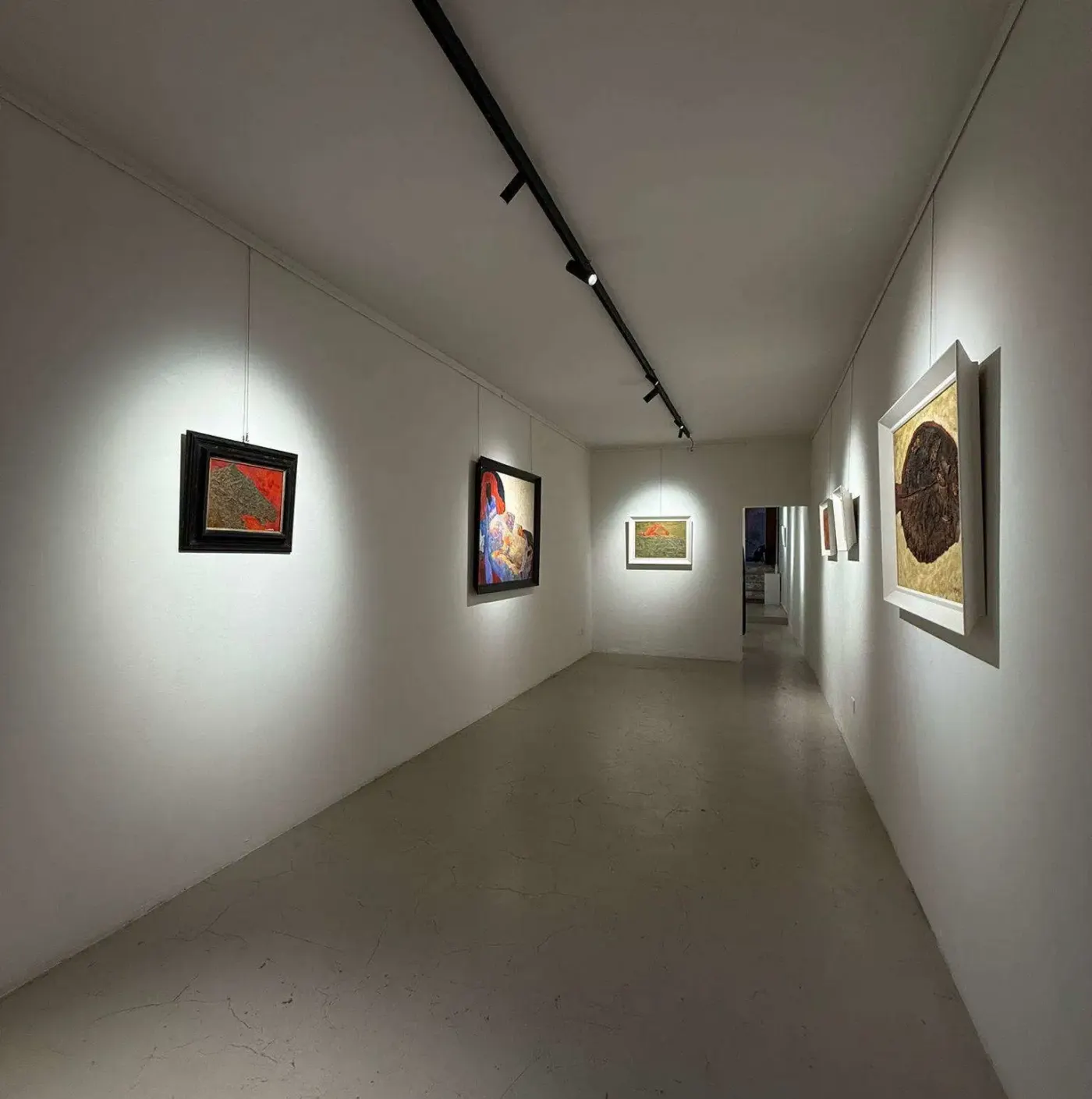
From May 3 to June 28, 2026, Art Studio La Marina in Pietrasanta presents Anteprima, the new solo exhibition by Beppe Madaudo (Giuseppe Madaudo; Palermo, 1950), curated by Diego Ferrante. The exhibition traces a path through some of the most recurring images in the artist’s practice, focusing on the relationship between figuration and matter, presence and dissolution, memory and transformation. The title of the exhibition does not simply refer to something yet to come; rather, it defines a condition of the image: that suspended phase in which form has not yet fully settled and remains crossed by traces, tensions, and stratifications. It is precisely within this threshold that Madaudo’s work takes shape — an artist who for decades has developed a pictorial research grounded in the sedimentation of matter and the persistence of figures.
The critical text accompanying the exhibition begins with the image of the John Dory fish, the first work encountered by visitors, depicting the animal linked to one of the best-known evangelical legends. According to tradition, the fish bears on its side two dark spots corresponding to the marks left by Saint Peter’s fingers when he pulled it from the sea in order to retrieve from its mouth the coin destined for tribute. That mark, impressed upon the fish’s body, becomes a memory inscribed in flesh, a trace crossing time itself. In Madaudo’s panel, the John Dory emerges through a red line that defines its outline with almost ritual precision. Within the silhouette, however, matter thickens into a surface composed of threads, burn marks, fragments, and superimpositions. The image thus appears inseparable from the traces that constitute it, as though form could exist only by preserving the marks of its own process of formation.
This procedure recurs throughout much of the artist’s work. The images never appear as isolated or definitive figures, but arise through successive accumulations that still allow what preceded their appearance to remain visible. Animals, human figures, and hybrid presences traverse the entire exhibition. Horses, felines, fish, and bodies recur as persistent elements, yet never identical to themselves. Each appearance alters the meaning of the previous image, preventing these subjects from becoming a mere iconographic repertoire. In their repetition, what emerges instead is a tension that precedes symbolic interpretation and directly concerns the force of the image itself.
The two paintings dedicated to horses constitute one of the clearest examples of this tension. The works present the same animal silhouette, yet against completely different backgrounds: one dominated by ash-grey tones, the other constructed around a deep burnt red. The figure’s design does not change; what changes is the way matter supports the image and alters its visual weight.
In the first horse, the presence seems suspended, almost held within an undefined space; in the second, the figure acquires density and gravity. Madaudo’s animals appear marked by restrained postures, compressed chromatic ranges, and eyeless gazes — elements that prevent any direct relationship with the viewer. They do not seek contact and do not return the gaze. The painting preserves this distance and transforms it into an autonomous form of existence.
The figure of the Odalisque further expands the field of the artist’s investigation. The reclining body emerges through a dense coloured surface upon which forms recalling fragments of landscape or memories without defined origin come to the surface. The dark head, devoid of features or direction, represents the only point withdrawn from visibility. It is a zone of opacity interrupting the immediacy of the figure and introducing a distance internal to the image itself. In this way, every work seems to preserve at least one unreachable portion, a margin that escapes full comprehension and prevents the figure from being entirely exhausted within representation. Madaudo’s painting thus becomes a space for the persistence of enigma, where the visible continues to preserve that which precedes it.
The Pietrasanta exhibition also offers an opportunity to reconsider Madaudo’s artistic trajectory. Born in Palermo in 1950 and trained at the Academy of Fine Arts, his career moves across different visual languages, from comics to painting, always maintaining a strong attention to the narrative and symbolic dimensions of the image. In 1975 he published Watanka, a work that earned him the Golden Yellow Kid Award as best Italian illustrator. Alongside painting, he continued to engage with comics and illustration, producing among other works the aquatint engravings for Casanova, published by Franco Maria Ricci Editore, the comics De Satyricon for Rizzoli, and I Quadri della Divina Commedia for Milano Libri. Throughout his career he also collaborated with numerous Italian editorial and media institutions, including Paese Sera, L’Espresso, and RAI.
His painting combines elements of the Western tradition with suggestions derived from Asian cultures — Madaudo spent a period in Japan, as demonstrated by his Wrestler of 1996, included in the exhibition — through a distinctive use of colour, gold leaf, and dense, layered pictorial matter. Madaudo’s works have been presented in numerous exhibitions in Italy and abroad, in cities such as New York, Kyoto, and Yokohama. In Anteprima, these elements converge into a path that does not proceed through linear narration, but through appearances and stratifications. The exhibition at Art Studio La Marina thus offers a compact vision of Madaudo’s poetics, highlighting the way painting can still become a place of tension between visible and invisible, form and matter, memory and transformation.
Finestre sull'Arte
24/05/2026