Beppe Madaudo
A subversive, a sympathizer, even a terrorist: these were the accusations that brought Beppe Madaudo to the dubious “honour” of judicial headlines because of the now well-known story of his comic strip on the Moro kidnapping, published in Metropoli.
“Of course I’m a subversive. I told the judge so myself. But the fact that I even portrayed Moro while he was a prisoner of the Red Brigades seems truly ridiculous to me!” says Madaudo, recalling that the judiciary ultimately agreed with him.
His drawings had been requested by the editors of the magazine — Piperno and Scalzone — simply because historical comics (and that case clearly belonged to the genre of historical comics as well) were, and still are, the kind of work best suited to the thirty-year-old illustrator from Palermo: for Garzanti, for Franco Maria Ricci, and also for RAI.
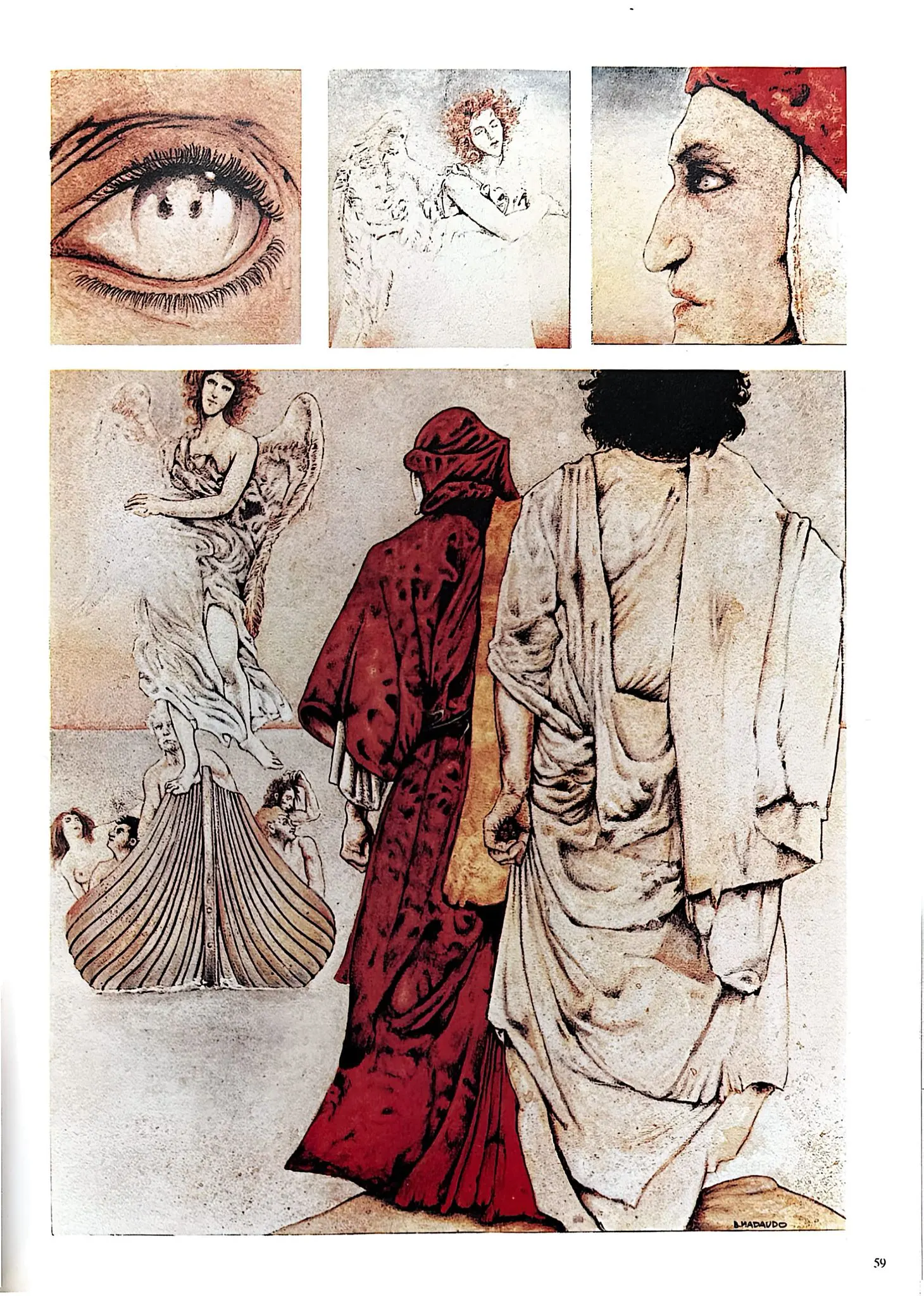
Among other works, Madaudo created comics dedicated to Napoleon, Casanova, and the October Revolution. An activity begun in Rome in 1975, immediately after graduating from the Academy of Fine Arts. An activity that soon made Madaudo one of the most sought-after illustrators of recent years — recognition also came in the form of awards at major national comic festivals such as Lucca and Prato.
Alongside comics, there is also his work as an illustrator for various record labels and for the weekly magazines L’Europeo and L’Espresso.
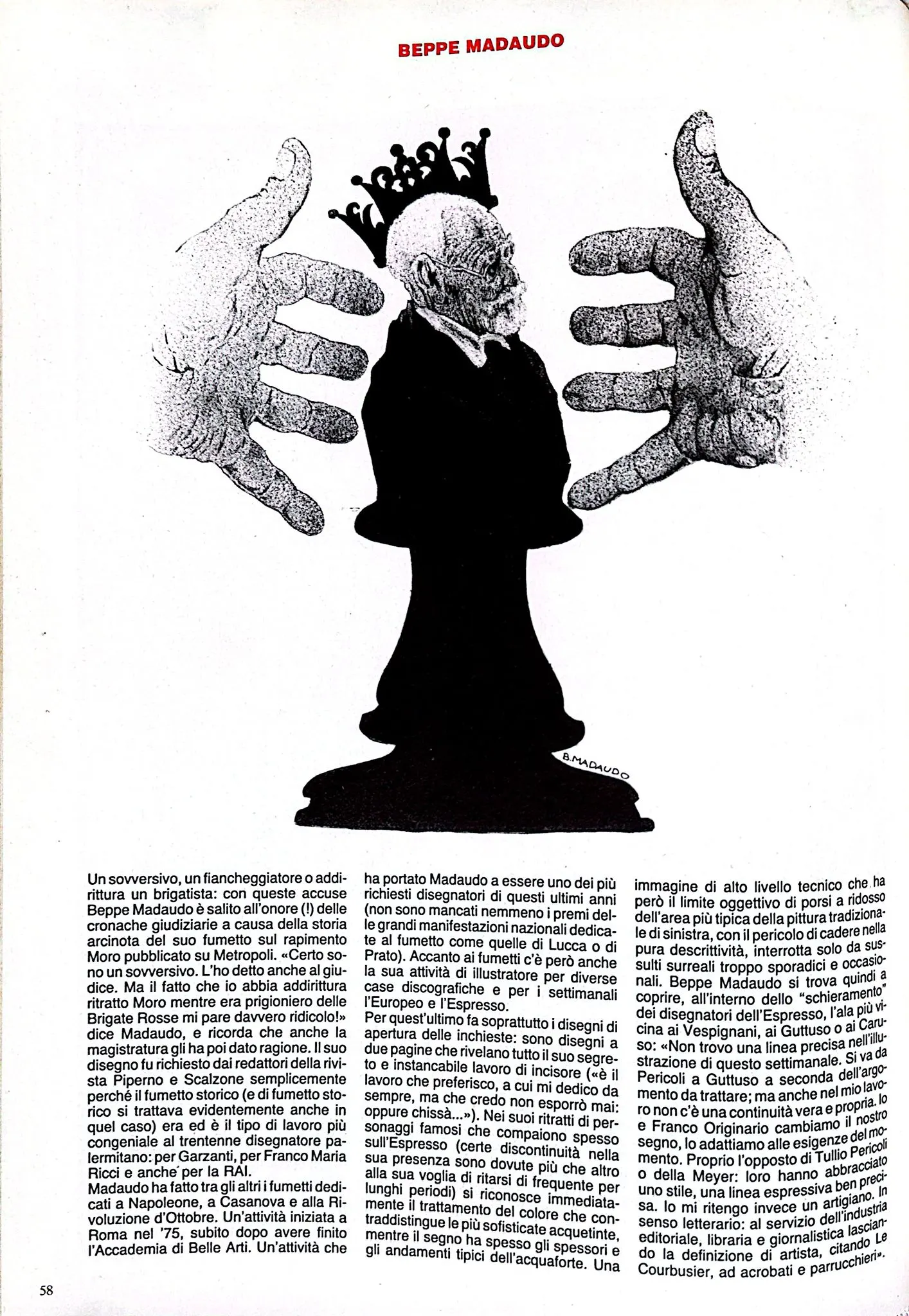
For L’Espresso, he mainly creates the opening illustrations for investigative reports: double-page drawings that reveal his secret and tireless work as an engraver (“it is the work I prefer, the one I have always devoted myself to, though I believe I will never exhibit it — although, who knows…”).
In his portraits of famous figures, frequently published in L’Espresso — certain interruptions in his presence there being due mostly to his habit of withdrawing for long periods — one immediately recognizes the colour treatment characteristic of the most sophisticated etchings, while the line itself often possesses the thickness and movement typical of aquatint engraving.
It is imagery of a very high technical level, though one that objectively risks remaining too close to the most characteristic territory of traditional left-wing painting, with the danger of slipping into pure descriptiveness, interrupted only occasionally by sporadic surrealist impulses.
Beppe Madaudo therefore occupies, within the “camp” of L’Espresso illustrators, the wing closest to artists such as Vespignani, Guttuso, and Caruso:
“I do not find a single precise line in the illustration style of this magazine. It ranges from Pericoli to Guttuso depending on the subject being addressed; but even in my own work there is no real continuity. Franco Originario and I change our mark, adapting it to the needs of the moment. The exact opposite of Tullio Pericoli or Meyer: they embraced a style, a clearly defined expressive line. I, on the other hand, consider myself a craftsman. In the literary sense: at the service of the publishing, book, and journalistic industry, leaving the definition of artist — to quote Le Corbusier — to acrobats and hairdressers.”
Zoom
October 1981