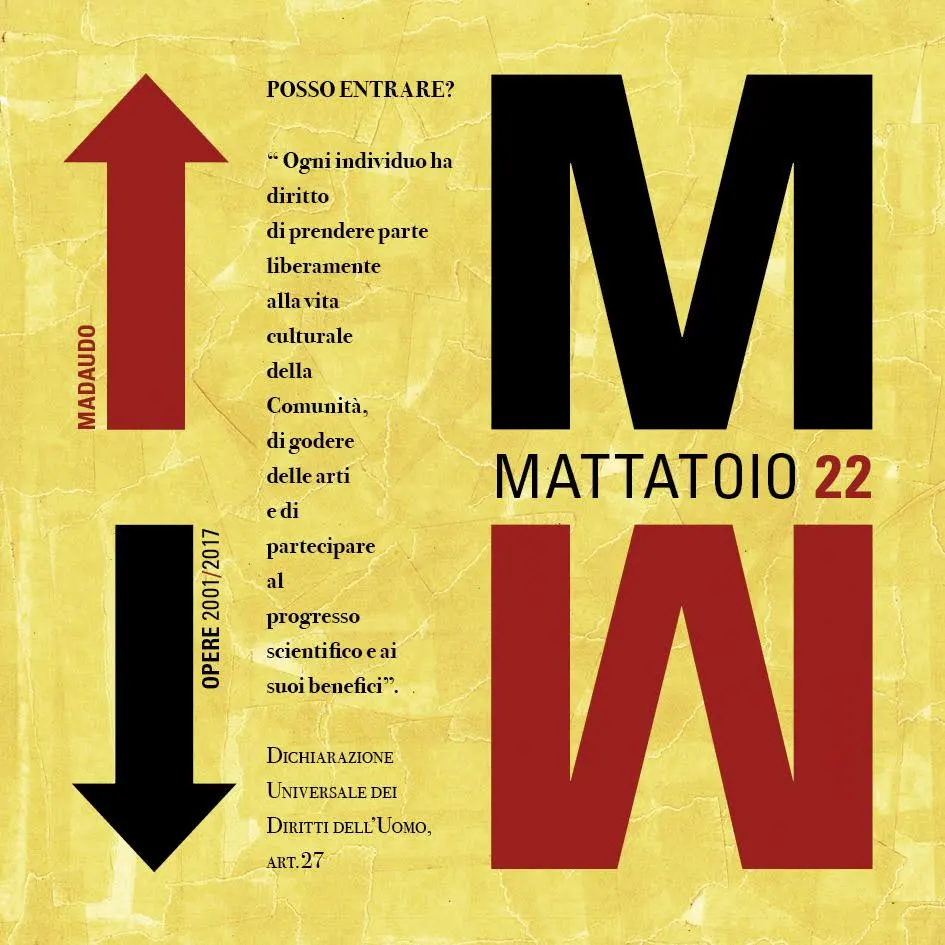
“A painting is a surface covered with colour. For the person who paints it, it may be one thing; for the person who admires it, it may be something else. The painting is completed by the viewer.” This concept is the most eloquent calling card of Beppe Madaudo, the Palermo-born artist whose exhibition, Mattatoio 22, was presented in preview in the hall of the former municipal slaughterhouse of Viterbo, made available by the Fondazione Carivit. It will be inaugurated on Friday, February 24, and will remain open until March 12.
But to define Madaudo’s exhibition simply as a painting show would be — indeed is — a blasphemy against art. Madaudo represents something unique on the international art scene, not only because simple colours are masterfully combined with wood, cotton, and hemp, but also because the figures themselves refer to the most varied sources: Arab culture and the animal world, between dream and reality. All of this is immersed in strong chromatic effects, which are never ends in themselves. Hence the invitation to a personal reading of the work.
In this specific case, Madaudo’s works were almost all inspired by, or in any case placed in dialogue with, the location: the former slaughterhouse in the Faul valley. On Friday, the day of the opening, a painted and already dismembered bull will be “distributed” to visitors. They will also be offered the opportunity to be photographed on a sofa created by the artist, thereby becoming an integral part of the work.
“A performance,” the painter explained, “that seeks to evoke the biblical phrase ‘Take this, all of you, and eat of it,’ in the belief that the vital content of food — and of art — can and must be shared with the widest possible audience.”
Attending the presentation of the exhibition were Mayor Leonardo Michelini, the President of the Fondazione Carivit, Mario Brutti, and the Commissioner of the Library Consortium, Paolo Pelliccia. These were not merely words of circumstance. “This exhibition,” the mayor pointed out, “is concrete evidence of the shoots of awakening that are beginning to bloom in the city; roots are fundamental when they serve to give life to new plants.”
For Commissioner Pelliccia, “the exhibition is also an experiment aimed at broadening the horizons of the Libraries to include art.” The Fondazione Carivit is willing to support the initiative. “This project, carried out together,” President Brutti emphasized, “is a sign of valuable synergy that encourages us to move forward.”