Self-Portrait of a New Author: Beppe Madaudo
Dear Bertieri, introducing oneself to readers is a difficult task. For me, it is doubly difficult, and I would gladly hand the pen to someone who could do it far better than I. But you asked me for a confession: here it is — if nothing else, it will at least be sincere.
I was born in Palermo in 1950. I studied at the art high school with little success, continuing, with ever-decreasing dedication, in the scenography courses at the Academy of Fine Arts in Rome, where I graduated with a thesis on Jackson Pollock, written together with a fellow student whom I had married three years earlier.
It was precisely during this Roman period that I first approached comics. It was a moment in which I looked with equal interest at Lautrec and Crepax, Goya and Battaglia.
It should not seem paradoxical — it is not.
While from graphic models I filtered the moods and sensibilities that would later serve me, I became fascinated by readings on the Russian theatrical revolution and by Meyerhold’s experiments in political and revolutionary theatre, which I naturally reflected upon within comics, imagining them in a popular context, with a culturally new vision that nevertheless was not foreign to the tradition of cartoonists.
After all, not even the most recent American underground experiences succeeded in altering this tradition, limiting themselves instead to exacerbating only its content while preserving the traditional structure.
Yet precisely during this ferment of ideas and suggestions, I was forced to interrupt my projects at the very moment they were taking shape. The necessity of work that could support me financially — I was not alone — became unavoidable. It was my enthusiasm that had to be postponed to better times.
I became part of a small team of graphic designers in an obscure Roman advertising agency where I learned manual discipline: for nine hours a day I drew posters, layouts, and storyboards, confronting hour after hour the most unrestrained consumerism and the dullest stupidity.
There I met a copywriter my own age, who gave me encouragement. Together we developed an old project of mine concerning the contemporary condition of Native American youth and their movement known as “Red Power.”
What emerged was a work particularly interesting from a historical and social point of view, since the texts were based on the very writings that had been sacred to the old Native Americans and remain so for the new generations. It was a patient labour of research, stitching together, and at times interpretation, from which emerged the old problems, the dramas, and the spirit of rebirth of all Native Americans, from the legendary elders to the young: from Sitting Bull to Vine Deloria (Custer Died for Your Sins, Jaca Book, Milan).
From a graphic point of view I was forced to proceed very slowly; over several months I managed with difficulty to draw only around twenty plates, occupied as I was with work that consumed almost my entire day. I therefore decided to suspend this activity — though only temporarily — and instead of drawing, I read.
Beckett and Ionesco guided me toward what would later become the defining choice in my comics: namely, to restore man to his nakedness even where he best succeeds in disguising himself — in his pretensions, his ignorance, and above all his cowardice, that tragic wall behind which his morality hides.
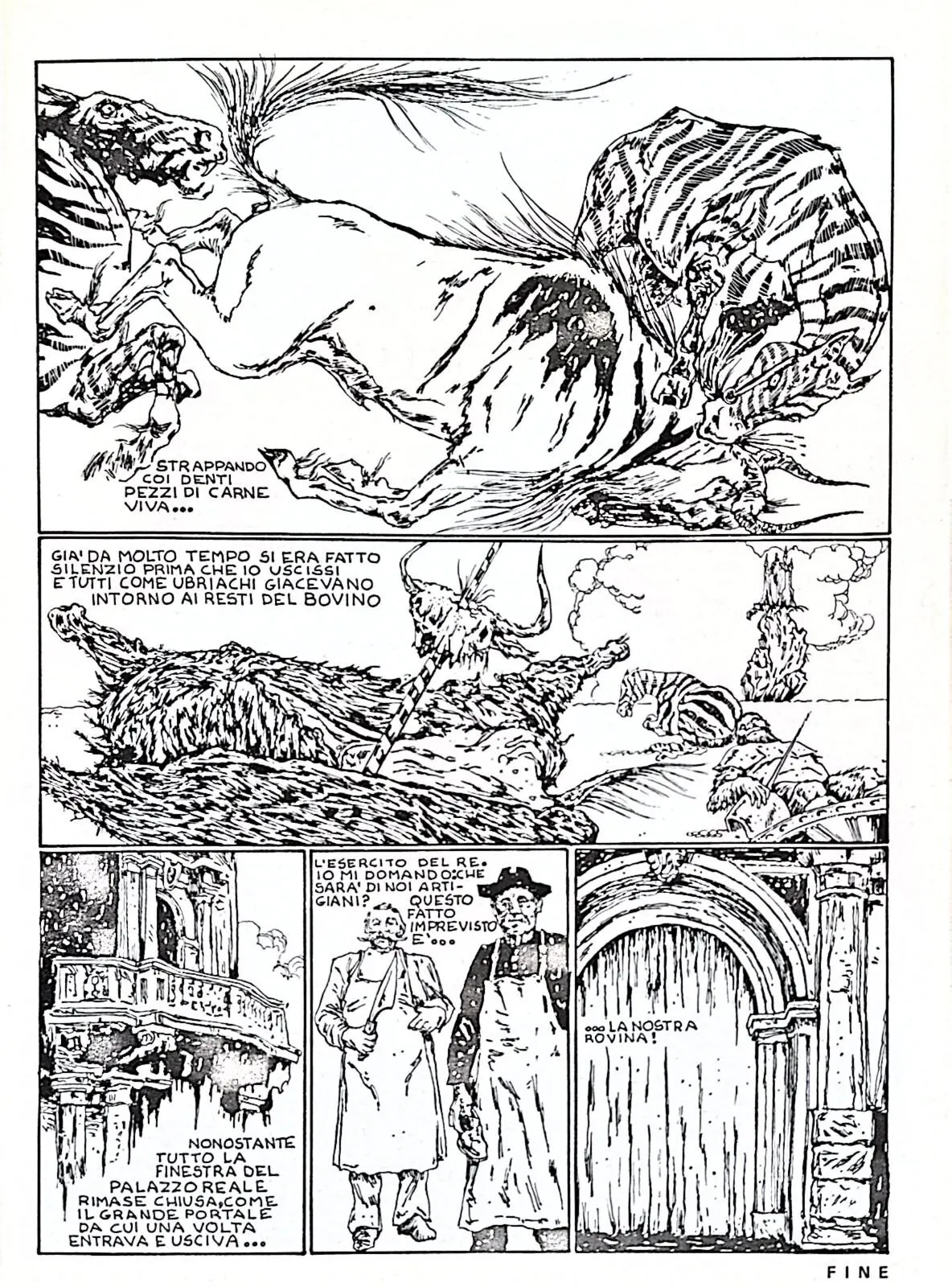
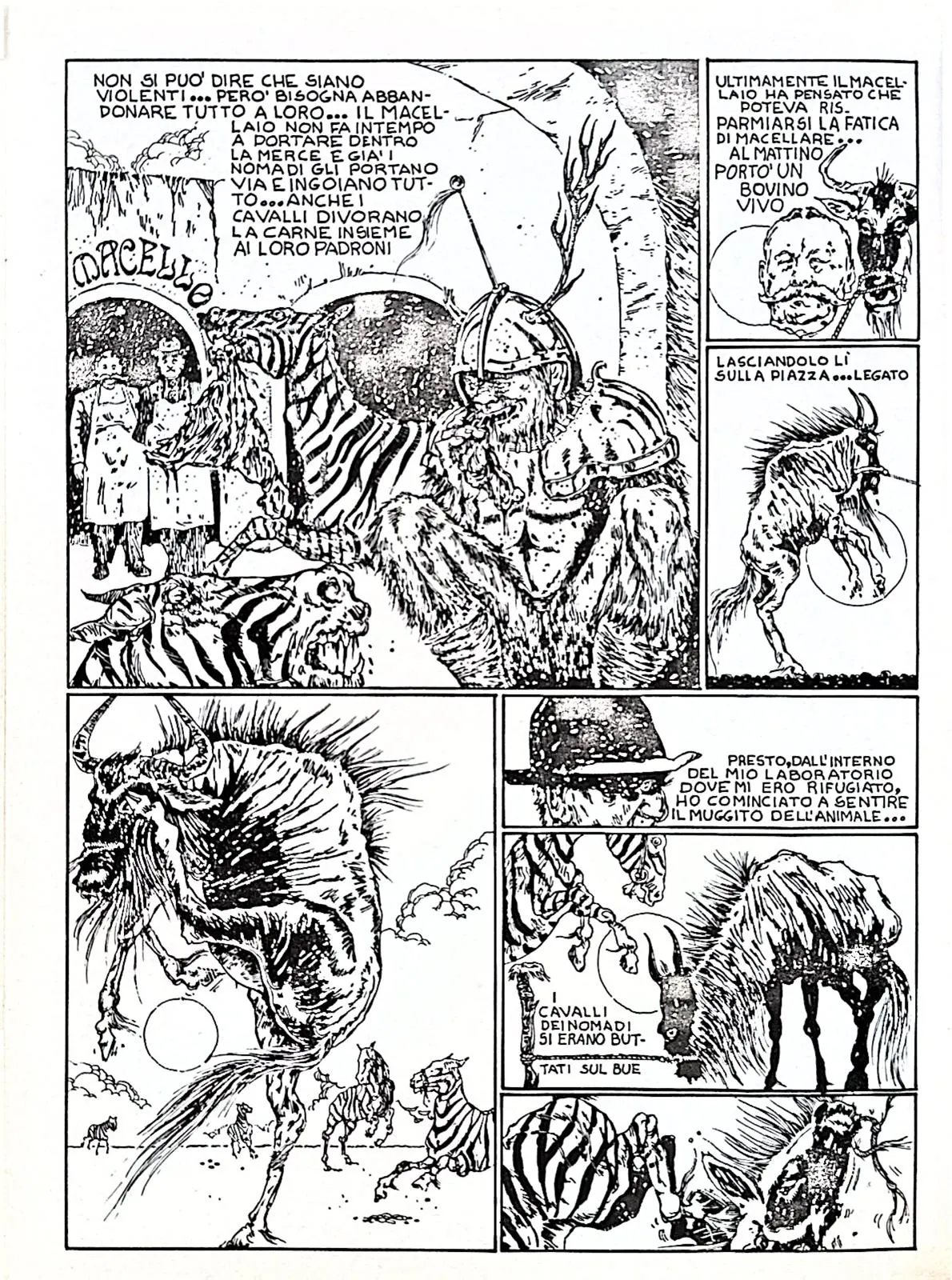
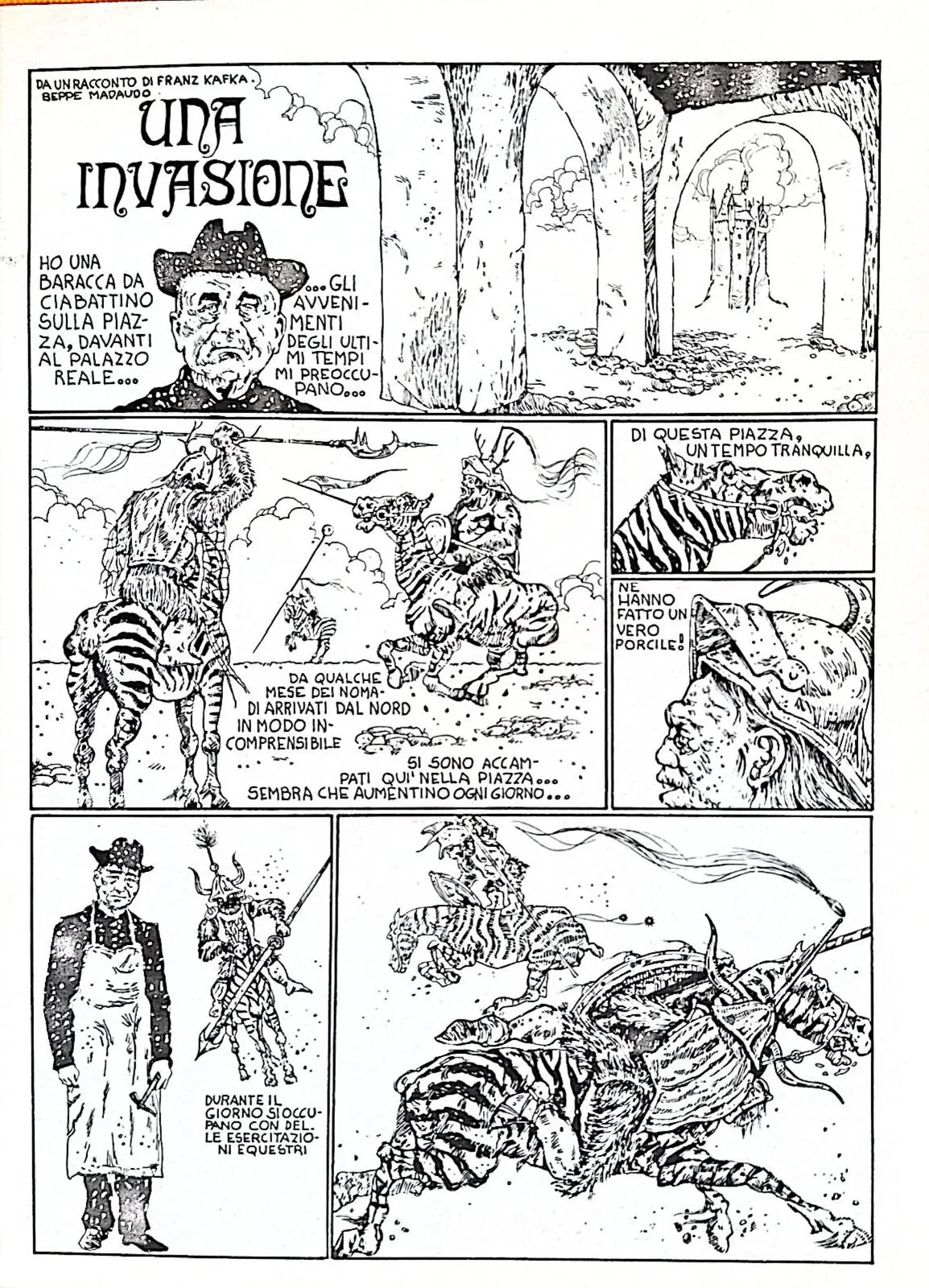
I also rediscovered Sartre, Kafka, and Villon. Rereading Kafka, I could not resist translating one of his stories into images, An Old Manuscript, which I retitled An Invasion. Into it I poured my enthusiasm, my most recent experiences, and also the anger of being forced to work only in rare fragments of free time.
In the end I decided to take the risk: I abandoned advertising and devoted myself to drawing comics — comics that aspired to demystify an illusory human reality in which the absurd becomes an opening between man and his earthly condition.
Beppe Madaudo X KIRK 42
April 1975