
I Paint Gold Backgrounds and Now I’m Blessed
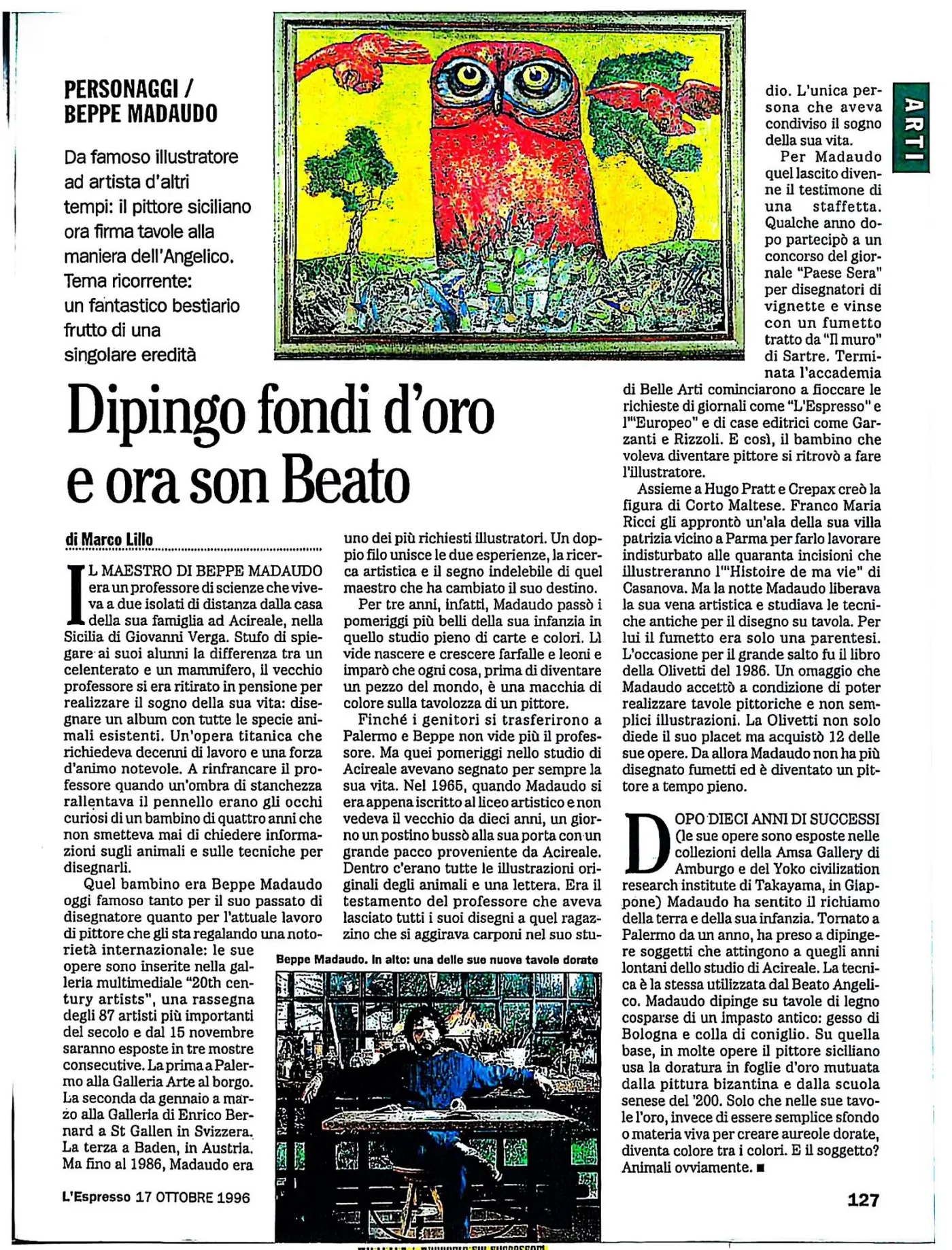
From Celebrated Illustrator to Old-World Artist: the Sicilian painter now creates panels in the manner of Fra Angelico. A recurring theme: a fantastical bestiary born from an extraordinary inheritance.
Beppe Madaudo’s teacher was a science professor who lived two streets away from his family home in Acireale, in the Sicily of Giovanni Verga. Tired of explaining to his students the difference between a coelenterate and a mammal, the old professor had retired in order to fulfil the dream of his life: to draw an album containing every existing animal species. A titanic undertaking that required decades of work and remarkable strength of spirit.
What encouraged the professor whenever a shadow of fatigue slowed his brush were the curious eyes of a four-year-old child who never stopped asking questions about animals and about the techniques used to draw them.
That child was Beppe Madaudo, today famous both for his past as an illustrator and for his current work as a painter, which has earned him international recognition: his works are included in the multimedia gallery 20th Century Artists, a survey of the eighty-seven most important artists of the century, and beginning on November 15 they will be shown in three consecutive exhibitions. The first in Palermo at the Galleria Arte al Borgo, the second from January to March at Enrico Bernard’s gallery in St. Gallen, Switzerland, and the third in Baden, Austria.
Yet until 1986, Madaudo was one of the most sought-after illustrators. A double thread connects the two experiences: artistic research and the indelible mark left by the teacher who changed his destiny.
For three years, Madaudo spent the happiest afternoons of his childhood in that studio filled with papers and colours. There he watched butterflies and lions come to life and grow, and learned that everything, before becoming part of the world, is first a stain of colour on a painter’s palette.
Then his parents moved to Palermo and Beppe no longer saw the professor. But those afternoons in the Acireale studio had marked his life forever. In 1965, when Madaudo had just enrolled in the art high school and had not seen the old man for ten years, a postman knocked at his door with a large parcel from Acireale. Inside were all the original animal illustrations and a letter. It was the professor’s testament: he had left all his drawings to that little boy who used to crawl around his studio floor — the only person who had shared the dream of his life.
For Madaudo, that legacy became the baton in a relay race. A few years later he entered a competition organized by the newspaper Paese Sera for comic-strip artists and won with a comic adaptation of Sartre’s The Wall. Once he had completed the Academy of Fine Arts, commissions began to pour in from magazines such as L’Espresso and L’Europeo, and from publishing houses such as Garzanti and Rizzoli. Thus the child who wanted to become a painter found himself working as an illustrator.
Together with Hugo Pratt and Crepax, he contributed to the creation of the figure of Corto Maltese. Franco Maria Ricci set aside an entire wing of his aristocratic villa near Parma so that Madaudo could work undisturbed on the forty engravings illustrating Casanova’s Histoire de ma vie. But at night Madaudo gave free rein to his artistic vocation and studied ancient techniques of painting on panel. For him, comics were only a parenthesis.
The opportunity for the great turning point came with an Olivetti book commission in 1986. Madaudo accepted on the condition that he be allowed to create painted panels rather than simple illustrations. Olivetti not only agreed, but purchased twelve of his works. From that moment onward, Madaudo stopped drawing comics and became a full-time painter.
After ten years of success — his works are held in the collections of the Amsa Gallery in Hamburg and the Yoko Civilization Research Institute in Takayama, Japan — Madaudo felt the pull of his homeland and of his childhood. Having returned to Palermo a year ago, he began painting subjects that draw upon those distant years in the Acireale studio.
The technique is the same used by Fra Angelico. Madaudo paints on wooden panels covered with an ancient mixture: Bologna plaster and rabbit-skin glue. Upon this surface, in many works, the Sicilian painter applies gold leaf derived from Byzantine painting and the Sienese school of the thirteenth century. Only in his panels, gold — instead of serving merely as a background or as living matter for the creation of halos — becomes one colour among other colours.
And the subject? Animals, of course.
By Marco Lillo
L'Espresso
17/10/1996