
Madaudo, the Visionary with a Hint of Fauvism
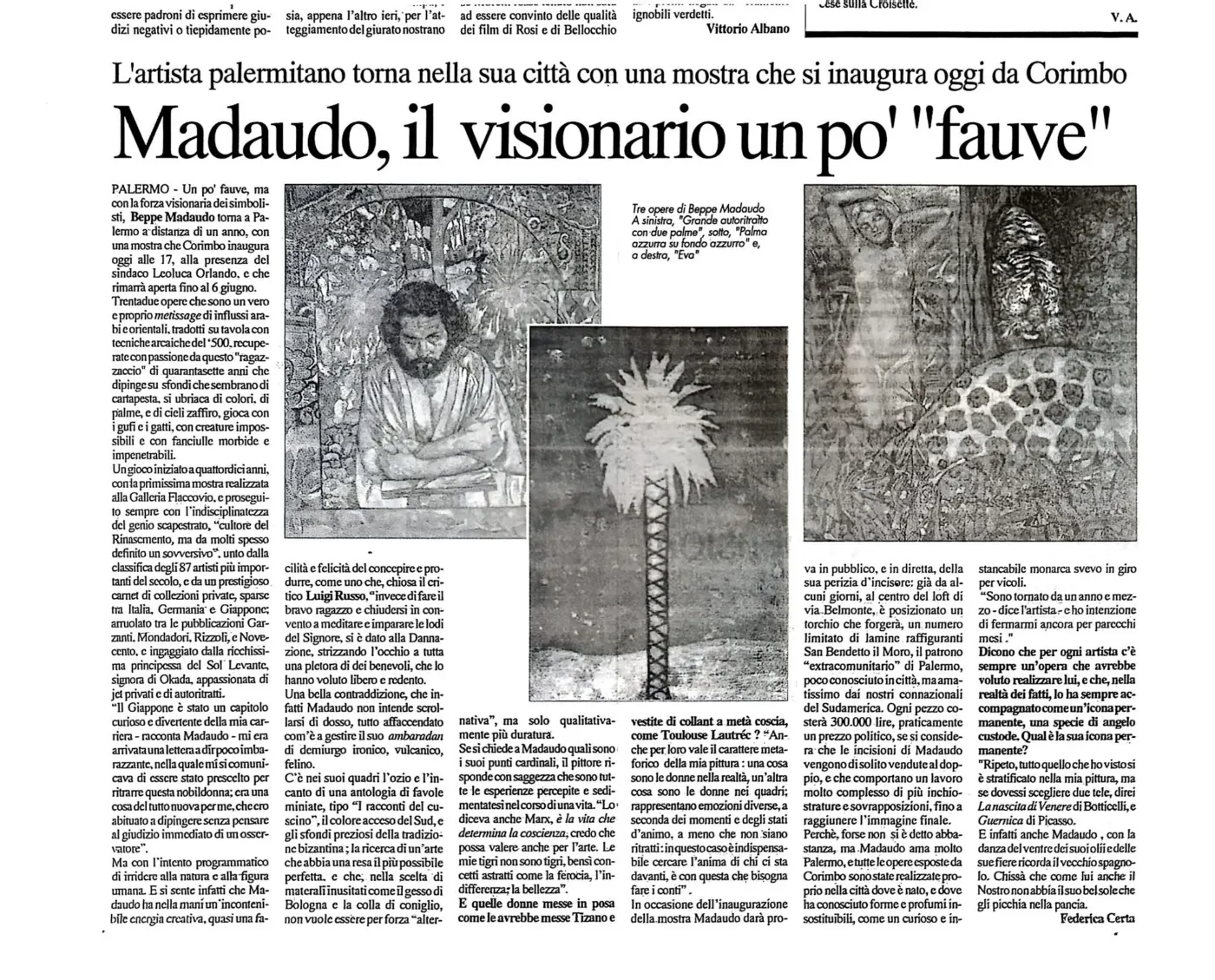
PALERMO — Somewhat Fauvist, yet endowed with the visionary force of the Symbolists, Beppe Madaudo returns to Palermo after a year’s absence with an exhibition inaugurated today at 5 p.m. at Corimbo, in the presence of Mayor Leoluca Orlando. The show will remain open until June 6.
Thirty-two works form a true métissage of Arab and Oriental influences, translated onto panel through archaic sixteenth-century techniques passionately revived by this “wild boy” of forty-four, who paints on backgrounds resembling papier-mâché, intoxicates himself with colour, palms, and sapphire skies, and plays with owls and cats, impossible creatures, and soft, impenetrable maidens.
A game that began at the age of fourteen with his very first exhibition at the Galleria Flaccovio, and continued with all the indiscipline of a bohemian genius, “a devotee of the Renaissance, though often labelled a subversive,” consecrated by inclusion among the eighty-seven most important artists of the century, and by a prestigious roster of private collections spread across Italy, Germany, and Japan. He has worked with publishers such as Garzanti, Mondadori, Rizzoli, and Novecento, and was commissioned by the wealthy Japanese Princess Okada, a lover of private jets and self-portraits.
“Japan was a curious and entertaining chapter of my career,” Madaudo recounts. “I received a letter from pompous ambassadors informing me that I had been chosen to portray this noblewoman; it was entirely new to me, since I was accustomed to painting without thinking about the immediate judgement of a viewer.”
Yet always with the deliberate intention of mocking nature and the human figure. One senses that Madaudo possesses an irrepressible creative energy in his hands, an almost effortless joy in conceiving and producing, like someone who, as critic Luigi Russo remarks, “instead of being a good boy and shutting himself away in a convent to meditate and learn the praises of the Lord, surrendered himself to Damnation, winking at a whole host of benevolent patrons who wanted him free and redeemed.”
A beautiful contradiction that Madaudo has no intention of shedding, fully occupied as he is in managing his arambandon of ironic, volcanic, feline demiurge.
His paintings contain the idleness and enchantment of an anthology of illuminated fables, akin to The Pillow Book, the vivid colour of the South, and the precious backgrounds of the Byzantine tradition; they embody the pursuit of an art rendered as perfectly as possible and which, through the choice of unusual materials such as Bologna plaster and rabbit-skin glue, does not aim to be “alternative” at all costs, but simply more enduring in quality.
When asked what his cardinal points are, the painter wisely replies that they consist of all the experiences accumulated and sedimented throughout a lifetime. “Marx said it too: life determines consciousness. I believe the same applies to art. My tigers are not tigers, but abstract concepts such as ferocity, indifference, beauty.”
And those women posed as Titian might have posed them, yet dressed in mid-thigh stockings like figures from Toulouse-Lautrec? “The same metaphorical character applies to them as well: women in reality are one thing, women in paintings another. They represent different emotions depending on moments and states of mind, unless they are portraits. In that case, it becomes essential to seek the soul of the person before you — that is what one must reckon with.”
On the occasion of the exhibition opening, Madaudo will publicly demonstrate his mastery as an engraver live: for several days, a printing press has stood at the centre of the loft on Via Belmonte, where he will produce a limited number of plates depicting Saint Benedict the Moor, Palermo’s “extracomunitario” patron saint, little known in the city but deeply beloved by South American emigrants. Each piece will cost 300,000 lire — practically a political price, considering that Madaudo’s engravings are usually sold for twice as much and involve a highly complex process of multiple inkings and overlays before reaching the final image.
Because perhaps it has not been said enough: Madaudo deeply loves Palermo, and all the works exhibited at Corimbo were created precisely in the city where he was born and where he encountered irreplaceable forms and scents, like a curious and tireless Swabian monarch wandering through alleyways.
“I returned a year and a half ago,” says the artist, “and I intend to stay for many more months.”
They say that every artist has a work they wish they had created themselves, one that accompanies them throughout life like a permanent icon, a kind of guardian angel. What is his permanent icon?
“I repeat, everything I have seen has stratified itself within my painting, but if I had to choose two canvases, I would say Botticelli’s Birth of Venus and Picasso’s Guernica.”
And indeed, Madaudo too — with the belly-dance movement of his oils and his beasts — recalls the old Spaniard. Perhaps, like Picasso, he too carries a blazing sun striking the back of his neck.
Federica Certa
Il Mediterraneo
22/05/1997